Returning to First Principles
It had been a long Saturday for Fellowship Conway’s men’s ministry team. They were tired, having spent hours marking page after page of flip charts. The goal of this strategy session was to understand where they were as a ministry and where they were going. And while no one wanted to say it out loud, the truth was they had functionally become an event-planning team. The same four events every year. Rinse and repeat.
Over time, a growing discomfort had settled in on the team. They sensed God was moving them in a different direction. He wanted to do more. Something had to change.
The problem wasn’t the events. They were good. Men enjoyed events like Men’s Muster, Fellowship’s annual men’s weekend. It was fun and included great teaching and discussion groups. Outside of their own small group, this was the only time some men connected with others in the church. The problem was how fleeting that sense of real community felt. It was there for a moment and — POOF! — it was gone. By Monday, men went back to normal. For some, that meant figuring out how to be a godly husband and father on their own. For many, it meant going back to a lonely life disconnected from others.
These men didn’t need another event. They needed a brotherhood.
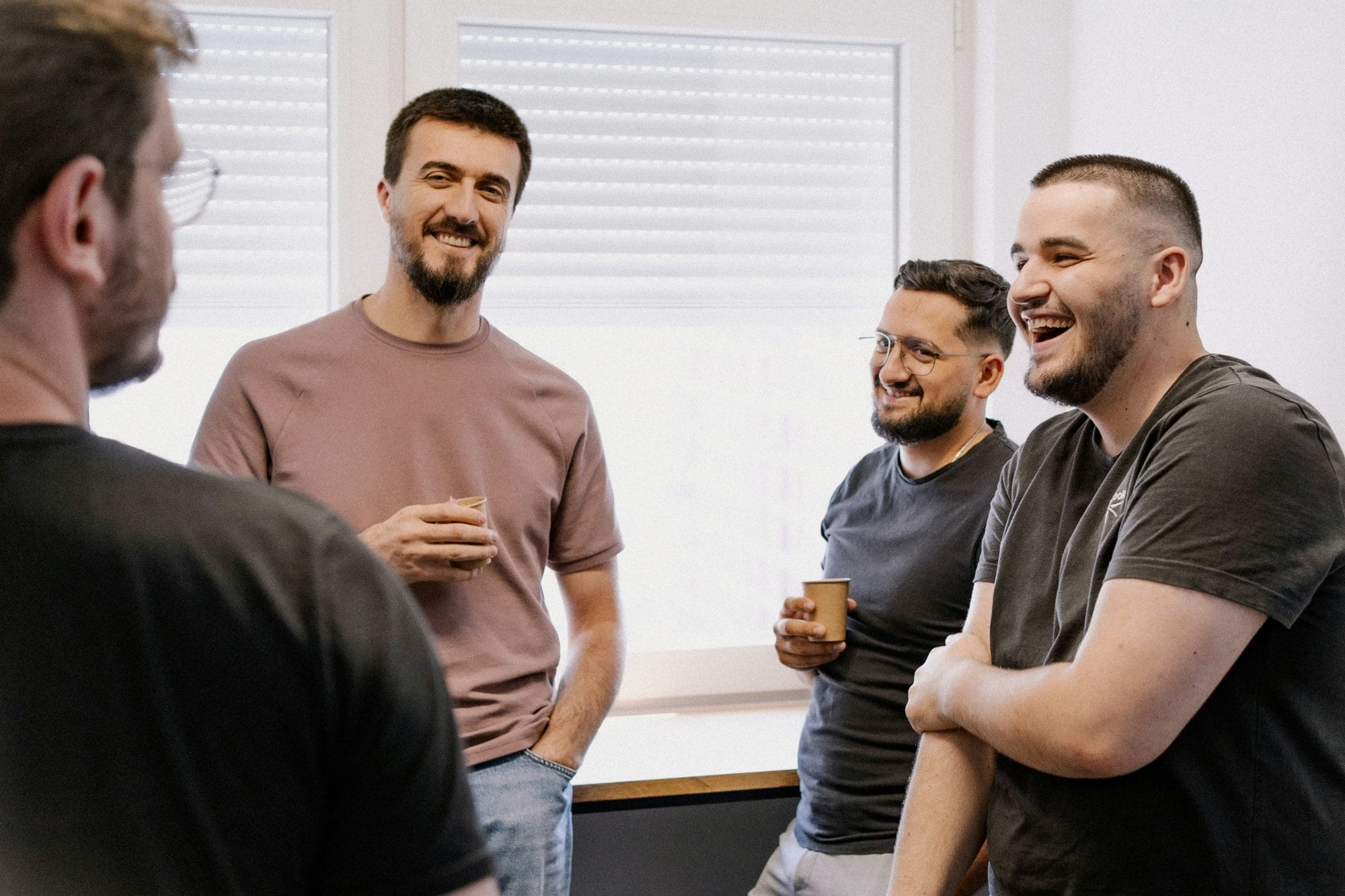
What emerged from the meeting was a renewed sense of purpose. Men’s Ministry was more than the events that brought men together. It was what God was doing among a community of men. In the coming weeks, the Men’s Ministry Team tried to capture this renewed purpose in a statement:
We are a brotherhood. Together, we are growing into solid, godly men.
The Philosopher
Josh Jolly is in his mid-thirties and a father of four. Josh’s personality is more that of a philosopher. He gravitates toward the deep questions of life and theology. He’s thoughtful and well-spoken.
While Josh is a thinker, he knows that faith is not relegated to what’s in your mind. “The substance of the faith always is going to be each other. It is community,” Josh says. “If people aren’t being tethered together, then we’re doing it wrong. We’re just promoting the ‘brain on a stick’ approach where we have equipped this many new brains on a stick to go and replicate and create more brains on a stick.”
Before his current job in IT sales, Josh spent three years in campus ministry at Hendrix College. In that role, he played to his strengths, which was getting guys together. “If you needed a room full of dudes, I could do that. Just give me a week on campus. But the thing is, so few of them ended up becoming followers of Jesus. Looking back, that’s something that’s hung on me. I don’t want people who love Josh Jolly. I want people who love Jesus.”
Josh is passionate about the next generation, especially men, and he sees a great challenge before men today.
I don’t believe that God has ever called us in any stage of life to be idle in any way. From the time when you and I are now to the day that we die, God is calling us closer and deeper, and there’s always more.
The meme of the current churchgoer in America today is the one whose life is stagnant. There’s nothing happening. There’s no development really happening. He goes to church, he does things, he checks the boxes, but outside of Sunday morning, or maybe even Sunday morning and small group, his life is actually affected very little. And it’s pretty hard to tell him apart from people who don’t go to church.
The Builder
Recently, John Lee retired from a career in the corporate world. For 50 years, he woke up every morning at 3:00 o’clock ready to work. While some people work to live, John lives to work. That’s just how he’s wired.
John is assertive and speaks his mind, often in a direct manner. He’s also an introvert. “I’m not strong on relationships. I think I don’t need anybody. Now, that doesn’t mean I don’t value others. But I’m not going to let the fact that I don’t have somebody to hold the other end of the board prevent me from building whatever it is I’m going to build. I’m going to figure out a way. That’s my personality.”
When asked what life is like in retirement, John says, “It sucks. Nobody cares when I wake up or what I do. But I’m not dead, so there’s a reason I’m still here. I have an opportunity to say, ‘Okay, what’s really important?’ And right now, there’s nothing in my life that is more important than getting a hold of what God wants me to do in this season.”
In looking for places to contribute, John found the Men’s Ministry team. Since joining, John has shown initiative in asking, “What do the men of Fellowship need? Where are the gaps?”
The Disciple-Maker
Michael Harrison is Fellowship’s Discipleship Pastor. He’s relational and a natural disciple-maker. Before joining the church’s staff, Michael spent 15 years serving with YoungLife, a ministry focused on discipling youth. As a leader and later the Area Director, Michael put in his reps, whether that was teaching others how to disciple or doing it himself.
Today, Michael focuses on how to equip and release church members to be reproducing disciples of Jesus Christ. Practically, that means plugging members into opportunities beyond the Sunday worship service, whether that is equipping classes on Sunday mornings or home churches (Fellowship’s small groups) throughout the week.
Michael wants Fellowship’s members to feel empowered. He knows others don’t have the background or relational personality he does. Multiple people have come to him, saying, “I want to disciple somebody, but I don’t know what to do.”
A Clear Discipleship Pathway
The Men’s Ministry Team wasn’t alone in sensing it. Other men were converging on a real need — a community of men growing together. That need led all of them to a series called The First Principles Series by BILD International.
Think of The First Principles Series as a modern-day catechism for believers. The series is a set of 13 six-session Bible study guides for establishing believers in the faith. Instead of your typical information-based, fill-in-the-blank approach, the series revives a serious, ordered approach to learning that is based in community dialogue.
Following the pattern of the early church, the series creates a clear discipleship pathway for understanding the core principles passed down from Christ and His Apostles. While other discipleship methods focus on information transfer from a master teacher, The First Principles Series teaches a new skill set for learning and growing in community. Ultimately, the series helps believers to think critically and biblically.
We Can Return
This fall, Fellowship’s Men’s Ministry will launch a group that includes all of these men on how to teach The First Principles Series. Something that drew Josh to the series was the challenge for believers to think. “The series begins with reframing the way we even think about our faith, specifically in the context of how it looks lived out. Not just taught, but reproduced. I’m really excited for that.” Josh goes on to say:
Everything about the gospel of Jesus Christ and following Him is presented as a monumental challenge. It’s not just, “Yes, I adhere to this worldview, and so this is the team I’m on.” It is a call to pick up your cross and follow Him. Every bit of the gospel is dripping with this language of there will be depths that you will never be able to chart, but you will spend the rest of your life trying.
More high church traditions have this association that it will ask much of you. That shouldn’t be unique to those traditions. What I love about the series is how all-inclusive it is. Imagine a disciple who was seriously trained, withheld, and kept in these parts of his life and thinking. How hard would it be for him to fall away? How unnatural would it be for him not to reproduce?
John is more concise with his feelings about the series:
Men have the opportunity to be transformed by what they’re learning as opposed to just learning what they’re learning.
For Michael, the series gives Fellowship something it currently lacks. “The series gives a clear path to help new believers and get them grounded in important things that can be a framework for future growth.”
The process of self-discovery is also something that appeals to Michael. “When you get people in the Scriptures, and those truths become real — not just theoretical — in their lives, that process of self-discovery takes root in a much deeper way than if you tell someone what to think or believe,” he says. It’s a pattern he’s seen change what happens next, too: “When light bulbs go off, and they really get it, the desire not just to learn but to pass it on becomes stronger.”
The group is a small step, and Josh sees what’s at stake for men today:
In our lifetime, we’ve witnessed insane shifts of reality itself being redefined. But we can return. We can be restored. It’s not too late, but it can only be done by a generation of men who, like their forebears, were unapologetic, unyielding, and faithful to the gospel of Jesus Christ. Not just as a precept or an underlying philosophy, but as a life in which you lead.
What I like about The First Principles Series is the systematic walkthrough of what that looks like. How that should be thought about, how that should be taught, how it should be reproduced, and how it should be lived. If that happened, what we talked about in those men who changed the world — that flame — can be reignited and fanned into a flame far greater than what it ever was before. But it has to start with one generation. Why not ours?
We’re grateful for the men of Fellowship Conway who are helping men grow together and be established in the faith. They are helping the whole Church grow.
Speaking the truth in love, we will grow to become in every respect the mature body of him who is the head, that is, Christ. From him, the whole body, joined and held together by every supporting ligament, grows and builds itself up in love, as each part does its work.
Ephesians 4:15-16