From Crisis to Career
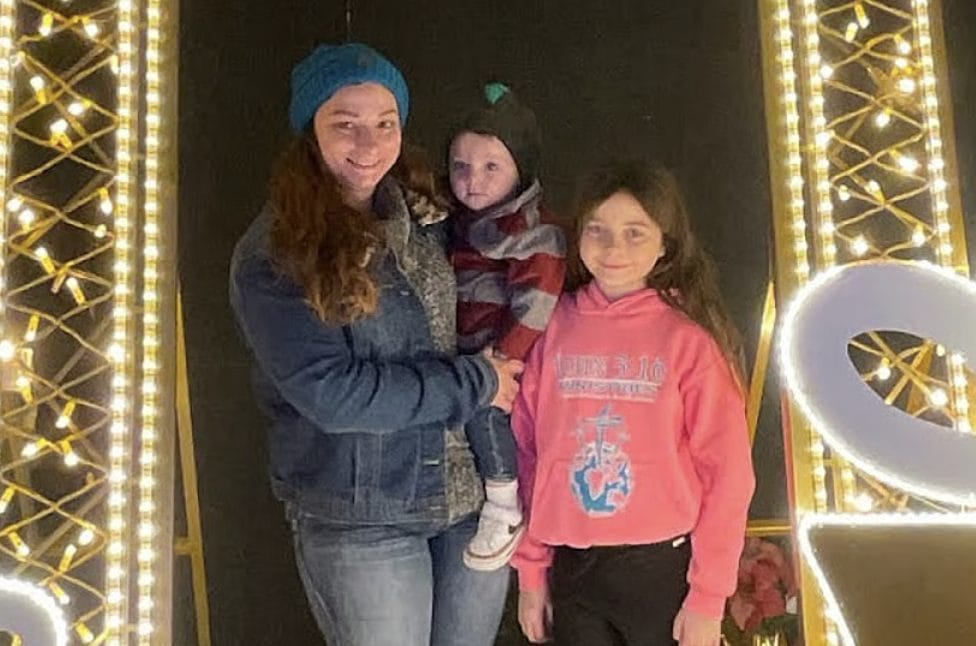
Betty Winders had been battling addiction for 14 years.
Then, in December 2024, everything fell apart. Already on probation and facing multiple charges, she was facing prison time. That’s when she made the hardest decision of her life: she placed her children in foster care so she could get help.
She entered rehab at In His Wings, a Christian-based recovery program. Slowly, Betty began to rebuild her life. She completed parenting classes, attended 12-step meetings, received counseling, got life-skills training, and found a job.
Before graduating from In His Wings, Betty heard about the 100 Families Initiative. She was determined to get her kids back. So, in July 2025, she enrolled. She connected with advocates, who helped her navigate her foster care and criminal cases. She earned a promotion at work, got all her charges dropped, graduated In His Wings, and secured a home.
Exactly one year to the day she lost custody, Betty got her kids back. She became the first parent in Craighead County history to do so within a year.
Betty already knows what she wants to do next. She wants to be a drug addiction counselor, to walk alongside other moms walking the same road she once did.
Unintended Consequences
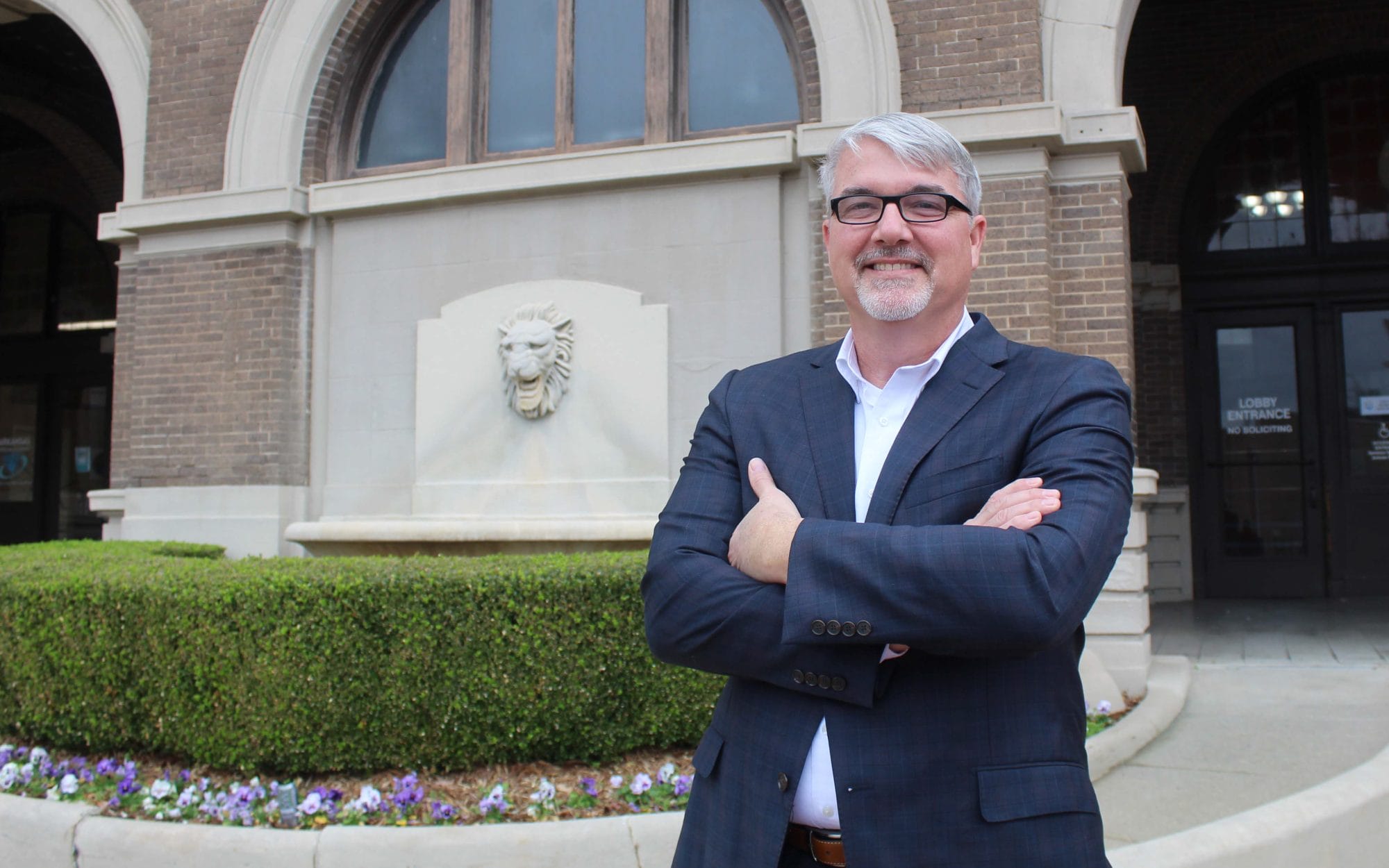
After working overseas in financial technology, Paul Chapman (Executive Director at Restore Hope) returned to the U.S. in the early 2000s and started volunteering at a local prison through his church. “Through trying to help some guys get out and stay out, I realized how hard it was for them — the complexity involved in gaining access to substance abuse treatment, work, a car, and all those things to get you back with your family,” says Chapman.
In 2006, Chapman joined Fellowship Bible Church full-time as Executive Pastor in Missions and worked closely with families impacted by corrections and foster care. In the years to come, Chapman saw the problem only get bigger. From 2012 to 2016, Arkansas had the fastest-growing prison population in the nation. “The unintended consequence of that was that the number of children who entered foster care was huge,” says Chapman. “It put a huge stress on our child welfare system.”
Along with Ray Williams, then on Fellowship’s staff, Chapman developed partnerships across Little Rock to serve families in need. Two of those partnerships were with the Department of Corrections and Arkansas Baptist College. “Inmates were being taken out of prison and taken to Arkansas Baptist College, a historically black college. They were going through a pre-release program, and it was going really well.”
The program was working, but they could only serve 200 people a year. The state was releasing 10,000 people from prison every year. “It was very clear that scaling individual programs wasn’t going to get us out of the trouble we were in,” Chapman says.
It Was So Kumbaya
In 2015, newly elected Governor Asa Hutchinson created a task force to address the state’s growing crises in incarceration and foster care. Chapman sat on the task force. “The governor put it on everyone. [He told us,] ‘We’ve got to figure out how we’re going to work together to address the crises that are going on in incarceration, in foster care,’” Chapman says. “It’s not that we couldn’t help anyone. It was that our best wasn’t good enough, and things had gotten worse.”
What the task force came up with was a collective impact approach that connects organizations across multiple sectors to provide the care people need. Hutchinson loved the idea and asked Chapman to help implement it, but he was reluctant.
“It was so kumbaya — the government’s going to work with the community, and everyone’s going to hold hands. We’re going to go to the toughest city that’s having the biggest problems — where it’s like a Jerry Springer show, chairs flying — and we’re somehow going to be kinder and gentler. It was so ambitious.”
Chapman was torn. He wished that he could give the job to someone else. But he told his wife, “I can’t face Jesus and tell Him I said, ‘No.’”
Collective Impact
The problem wasn’t a lack of effort. It was a lack of coordination. “Agencies operate in silos. Nonprofits work in silos. Churches work in silos,” Chapman says. State agencies and nonprofits were working hard. But they weren’t working together.
In response, the task force created a plan to link government agencies and community organizations. What they came up with was a collective impact approach that launched as the 100 Families Initiative in Sebastian County in 2016. The model called for an alliance of community partners that created a continuum of care to help someone move from crisis to stability and, eventually, a career.
Chapman compares the collective impact approach to building a house. “You’ve got plumbers and electricians. They go deep in their field. But you wouldn’t ask any one of them to build the house. There are professionals in the human service world who deliver expert-level services, and a client usually needs more than one of those at the same time. But there’s no coordination.”
As the backbone organization, Restore Hope acts as the general contractor, coordinating all the professionals involved. The 100 Families Initiative is a collection of alliances across Arkansas that provide on-the-ground connections and support using Restore Hope’s model.
The tool that makes it work is HopeHub, Restore Hope’s case management software that connects service providers on a participant’s care team. When someone walks in for help, a family advocate assesses their situation across thirteen areas — housing, employment, recovery, transportation, and more — and builds a care plan. Everyone working with that participant can see their progress in real time.
In Russellville, local leaders say HopeHub changed everything. For Journey Church Lead Pastor Steve Pyle, it transformed how his church measures success. Before HopeHub, success meant attendance and donations. Now it means something more tangible. “We can point to families who are still together, people who’ve been working steady jobs for two years, kids who have food, transportation, and stability,” Pyle says.
For Russellville Police Chief David Ewing, it changed how his officers do their jobs. Before HopeHub, his department was the default resource for every crisis call. “We used to be the Yellow Pages for everything,” Ewing says. “People would call us at two in the morning needing food, housing, or mental health help, and we didn’t always know who to call.” Now, officers can connect people directly to the help they need. “It lets us get back to what we’re supposed to be doing while knowing people are still getting help.”
She Kept Going
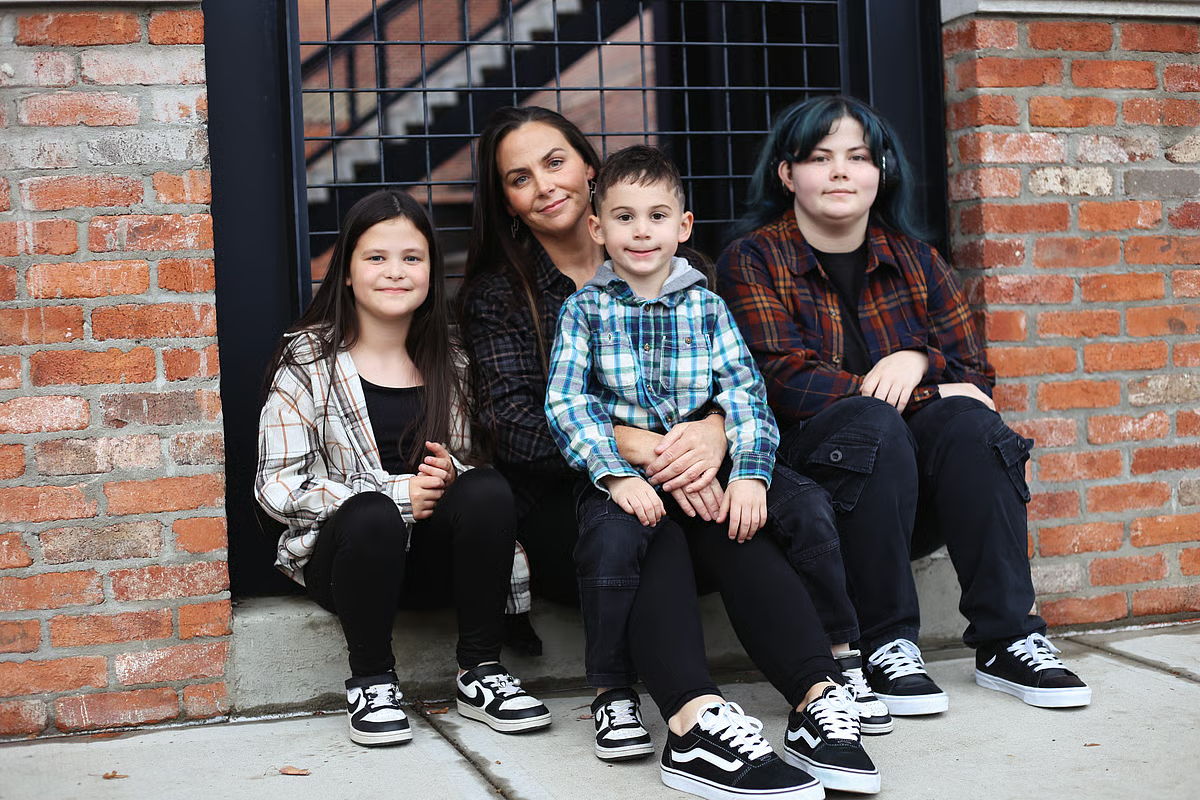
Christina was a single mother of three who had run out of options.
“At my lowest point, I didn’t have anyone,” she says. “I didn’t have a family I could rely on. I didn’t have friends I could turn to. I felt completely alone.”
That’s when the 100 Families Initiative of Sebastian County stepped in. Volunteers repaired her home. Community partners donated furniture, bedding, kitchen supplies, and toys. Melinda, one of the volunteers, offered her a job. Things started looking up for her.
Then her stepfather asked her to leave their trailer, leaving her and her kids homeless. She also lost her job. But Christina refused to give up. She kept going — kept applying for jobs, kept showing up for her kids. With every setback, 100 Families was there for her, providing what she needed to take the next step.
In September 2021, Christina and her children moved into the Community Rescue Mission (CRM). Slowly, things began to turn around. She got a job at Home2 Suites. Head Start provided childcare, United Way helped her with gas cards, and she got a seasonal job with Grainger. DHS helped her get housing assistance, and she got her driver’s license reinstated.
Christina began focusing on earning her GED and Certified Nursing Assistant (CNA) license. After getting both of them, she started working at Mercy Hospital.
The nurses she worked with encouraged Christina to apply for nursing school. Working full-time, raising three kids, and going back to school in her thirties felt daunting. But the words of her supervisor gave her the courage to go for it: “You have the heart of a nurse.”
Christina enrolled in nursing school at ATU-Ozark. Today, she’s a straight-A student.
The support network 100 Families provided showed Christina that she wasn’t alone. “For the first time in a long time, I felt seen. I felt supported,” she says. “They showed me that I could trust people, that I wasn’t meant to walk this journey by myself, and that asking for help isn’t weakness — it’s strength.”
Later, at a 100 Families Appreciation Event, Christina shared: “For every resource, every act of kindness, every prayer, every late-night conversation reminding me why I started — I want you to know it mattered. It changed my life.”
A Safe and Happy Home
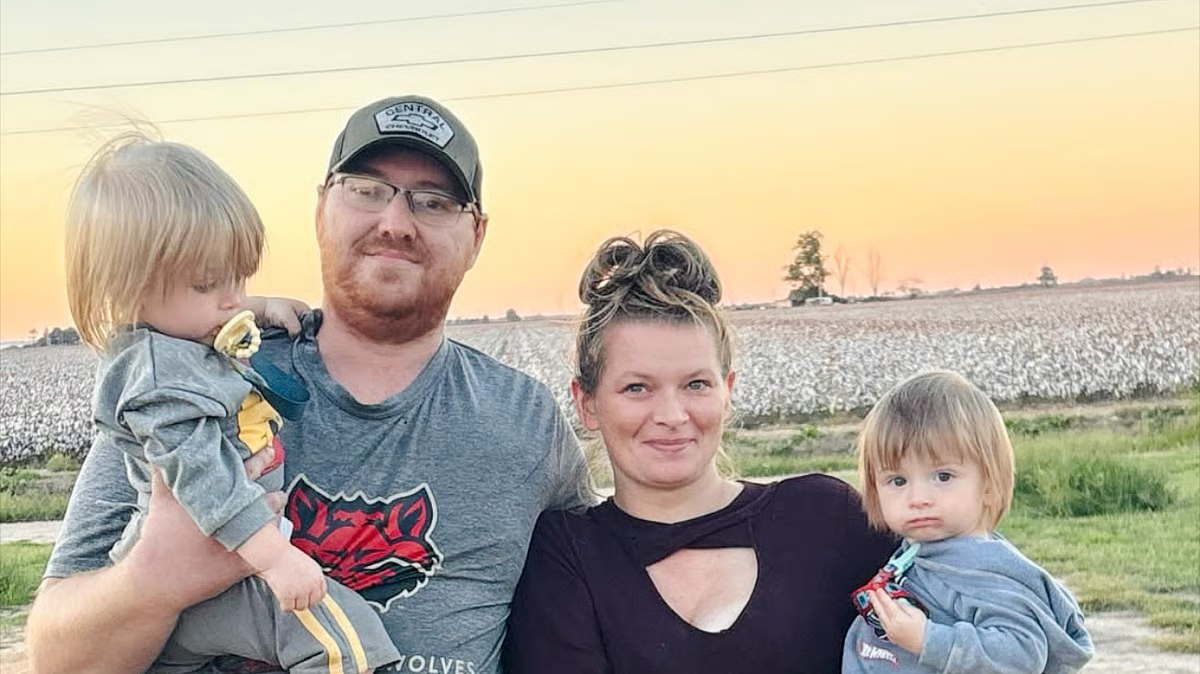
Steven was facing one of the hardest seasons of his life. His wife was incarcerated. His job gave him little purpose and stability. He wanted more for his family, but was having to carry all the weight with his wife in prison. With an open DCFS case, his twin boys were placed in foster care, making an already bad situation worse.
Steven wanted to rebuild his life and his family. Through the 100 Families Initiative, Steven worked with a family advocate on goals to reunite his family and create a stable home. He created a résumé and started looking for jobs that aligned with his goals. Volunteers helped him complete the required substance abuse classes and navigate his DCFS case.
With the help and encouragement of others, Steven stayed the course. In May, his wife returned home. He found a steady job with the service department at Central Chevrolet in Jonesboro. And he has stayed sober for two years. On August 30, Steven and his wife reunited with their two boys and brought them to a safe and happy home.
No Wrong Door
As of this writing, 2,277 people have moved from crisis to career through the 100 Families Initiative. The reunification rate in foster care is 68%, which is much higher than the national average. The same is true in employment retention, which is 85%.
What started in one county has grown to 19 Arkansas counties, spread to communities in Michigan, Iowa, Tennessee, Texas, and Canada, and served more than 11,000 people in crisis. Communities across North America are taking notice.
In Arkansas, Governor Sarah Huckabee Sanders has built her 10:33 Initiative around the model. Named after Jesus’ parable of the Good Samaritan, the initiative unites churches and state government to provide wraparound support for every Arkansan in need. The initiative is launching statewide to ensure “no wrong doors” for anyone seeking help.
The initiative is eliminating barriers to care by integrating HopeHub to build support teams around clients. “Instead of having to navigate a maze of agencies and applications, families will experience real coordination, real support, and real follow-through,” says Morgan Warbington of the Governor’s Office.
Churches play a vital role in the initiative. “Church participation is essential to the success of the 10:33 initiative,” says Warbington. “Together, we can build something bigger than any one organization and show what’s possible when faith and government services stand united.”
In the next three to five years, Restore Hope plans to help two to three new states replicate its model every year. And just like Arkansas, those states will have their own local alliances that will create solutions with their own leaders.
Stories like Betty’s, Christina’s, and Steven’s are happening across Arkansas. Restore Hope is proving that when communities work together, families don’t just survive.
They flourish.
BIBLIOGRAPHY
Chapman, Paul. Interview by Wonks at Work (podcast). “Come Healing: Paul Chapman.” Accessed April 1, 2026. https://soundcloud.com/wonks-at-work/come-healing-paul-chapman.
Chapman, Paul. “Restore Hope Arkansas Model.” YouTube video transcript. Accessed April 1, 2026. https://www.youtube.com/watch?v=FlObD-a4KlU.
Ramsey, Kayley. “A Father Builds Stability and Reunites With His Family.” Smart Justice, December 17, 2025. https://smartjustice.org/100-families/a-father-builds-stability-and-reunites-with-his-family.
Ramsey, Kayley. “A Mom Who Fought for Her Kids and A Community Who Believed in Her.” Smart Justice, November 24, 2025. https://smartjustice.org/100-families/a-mom-who-fought-for-her-kids-and-a-community-who-believed-in-her.
Ramsey, Kayley. “Recovery and Reunification for Betty’s Family.” Smart Justice, February 9, 2026. https://smartjustice.org/100-families/recovery-and-reunification-for-bettys-family.
Steward, Karen. “How HopeHub Transformed A Community: ‘It’s the Secret Sauce.’” Smart Justice, October 31, 2025. https://smartjustice.org/100-families/how-hopehub-transformed-a-county.
Steward, Karen. “10:33 Initiative Unites Church and Government for ‘No Wrong Door.’” Smart Justice, March 3, 2026. https://smartjustice.org/100-families/1033-initiative-unites-church-and-government-for-no-wrong-door.
“100 Families Overview: A Collaborative Approach.” YouTube video transcript. Accessed April 1, 2026. https://www.youtube.com/watch?v=E3YKX9YvdOI.